On Saturday, February 16, 2013, Valley Forge Audubon Society held a Great Backyard Bird Count event at the John James Audubon Center at Mill Grove. The day started out with a bird walk lead by Vince Smith which saw 32 bird species, the highlight being a Peregrine Falcon. The complete list of those birds follows:
Canada Goose 250
Common Merganser 4
Great Blue Heron 1
Turkey Vulture 4
Cooper's Hawk 1
Red-tailed Hawk 1
Mourning Dove 2
Red-bellied Woodpecker 3
Downy Woodpecker 2
Hairy Woodpecker 1
Northern Flicker (Yellow-shafted) 2
Pileated Woodpecker 1
Peregrine Falcon 1
Blue Jay 4
American Crow 4
Carolina Chickadee 4
Black-capped Chickadee 2
Tufted Titmouse 3
Red-breasted Nuthatch 1
White-breasted Nuthatch 1
Carolina Wren 3
Eastern Bluebird 2
Yellow-rumped Warbler (Myrtle) 2
Song Sparrow 3
White-throated Sparrow 22
Dark-eyed Junco (Slate-colored) 5
Northern Cardinal 5
Red-winged Blackbird 6
Common Grackle 1
Purple Finch (Eastern) 1 Female
House Finch 14
American Goldfinch 2
After the walk, a feeder watch was conducted at the cottage. This gave the walk attendees a break from the cold where they were treated to hot chocolate, courtesy of the John James Audubon Center at Mill Grove. Through the large picture window, 18 species of birds were seen attending the feeder and in the immediate area. The feeder watch gave us a great opportunity to see the difference between Carolina Chickadees and Black-capped Chickadees, as both species were visiting the feeder at the same time. A list of those birds follows:
Canada Goose 8 Flying overhead
Red-tailed Hawk 1 Soaring overhead
Red-bellied Woodpecker 1
Yellow-bellied Sapsucker 1
Downy Woodpecker 3
Blue Jay 1
Carolina Chickadee 5
Black-capped Chickadee 3
Tufted Titmouse 3
Red-breasted Nuthatch 1
White-breasted Nuthatch 2
Carolina Wren 1
Song Sparrow 2
White-throated Sparrow 1
Dark-eyed Junco 9
Northern Cardinal 3
House Finch 1
American Goldfinch 1
The Great Backyard Bird Count is an annual citizen science event held every February that gives researchers a clear view of bird populations prior to Spring migration through the observations of birdwatchers from around the world.

Monday, February 18, 2013

Monday, February 4, 2013
Winter Bird Counts Connect Kids to Birding
By Debbie Beer
This past winter, PA Young Birders (PAYB) was thrilled to engage more than 100 adults and children in several WINTER BIRD COUNTS FOR KIDS. Inspired by long-running, international Christmas Bird Counts, PAYB, along with partners and volunteers, guided these exciting, citizen science programs at two Important Bird Areas (IBAs) in Pennsylvania, highlighting a diversity of avian species thriving in preserved habitats.


A week later, on December 21, 2012, nearly 40 5th graders from Pepper Middle School walked over to John Heinz National Wildlife Refuge for their first-ever Winter Bird Count. After a colorful program presentation, two groups of enthusiastic students went outside with binoculars and checklists to search for birds in woods and wetlands. The kids were engaged and interested, completing a solid citizen science effort to find 19 species and 187 birds on a windy, chilly morning. This event served as one of over a dozen science classes taking place at Heinz Refuge for the Pepper School fifth graders, through the 2012-13 academic year. For most of these city students, visits to Heinz Refuge mark their first experiences walking in the woods, and observing wildlife up-close.
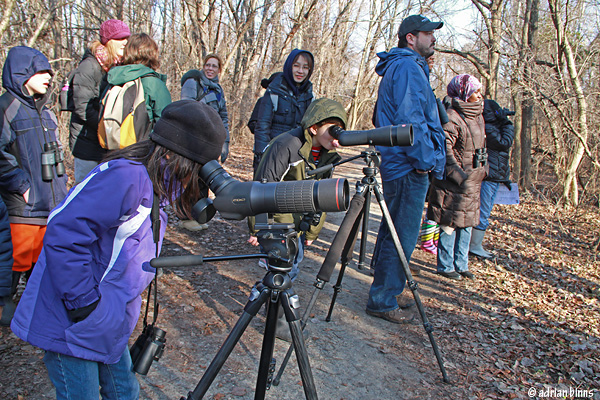
On January 5, 2013, more than 55 people came out to participate in the 3rd annual Winter Bird Count for Kids at Heinz Refuge. PAYB leaders guided two groups around the refuge, exploring woods, fields and creek habitats. The 200-acre water impoundment was almost completely frozen, so ducks were scarce, but we found a total of 37 species, 387 individual birds. During the tally rally, data was submitted to E-bird, and hot pizza was enjoyed by all. Highlights: Bald Eagles, Cooper's Hawk, numerous 130 gulls on ice, Brown Creeper, Golden-crowned Kinglets, sparrows, woodpeckers, Great Blue Herons, and one adorable Saw-whet Owl!
Thanks to everyone who contributed to connecting kids to birds and nature through these inspiring Winter Bird Counts - PA Young Birders, Friends of Heinz Refuge, Heinz Refuge, International Institute for Advanced Instruction, Pepper Middle School, Willistown ConservationTrust, and volunteers.
Sunday, January 27, 2013
PA Young Birders Gets Kids Involved in the Great Backyard Bird Count

PA Young Birders guides two Great Backyard Bird Count (GBBC) events in our region! Get involved in this exciting, citizen-science activity - fun for the whole family! No experience necessary. Bring binoculars, or borrow on-site.
These GBBC events are part of a 4-day, international effort that engages bird watchers of all ages in counting birds, to create a real-time snapshot of bird activity. Participants in the 16th annual Great Backyard Bird Count tally the number of birds seen or heard in a specific location, then enter their observations on the GBBC website: www.birdsource.org.

Join us at these dates/locations below:
Saturday, February 16, 2013 - 9:00 AM to 12:00 noon.
GREAT BACKYARD BIRD COUNT, at John Heinz National Wildlife Refuge.
8601 Lindbergh Blvd., Philadelphia PA 19153.
Suitable for ages 8+. Meet at the Refuge Visitors Center.
For group registration, email payoungbirders@gmail.com.
Sunday, February 17, 2013 - 9:00 AM to 12:00 noon.
GREAT BACKYARD BIRD COUNT, at Rushton Woods Preserve
On Delchester Road, just south of intersection with Goshen Road, Newtown Square PA.
For kids ages 7-12. (Parents welcome too). Meet at Rushton Woods parking lot/shed.
Please register with Ms. Blake Goll, bhg@wctrust.org.
Check the PA Young Birders website: www.payoungbirders.org for more information about our field trips, programs and partners.
Sunday, January 20, 2013
Field Report: Exton Park, January 20, 2013
On Sunday January 20, 2013, Vincent Smith lead a bird walk at Exton Park in West Whiteland township that saw 36 species, including American Black Duck, Bald Eagle, Red-shouldered Hawk, Horned Lark, American Tree Sparrow, and Rusty Blackbird. The complete list, as submitted to eBird follows:
Canada Goose 150
American Black Duck 2
Mallard 25
Great Blue Heron 2
Black Vulture 2
Turkey Vulture 8
Cooper's Hawk 1
Bald Eagle 1
Red-shouldered Hawk 1
Red-tailed Hawk 5
Ring-billed Gull 25
Rock Pigeon 12
Mourning Dove 62
Belted Kingfisher 1
Red-bellied Woodpecker 1
Downy Woodpecker 5
Northern Flicker 2
Blue Jay 2
American Crow 75
Horned Lark 3
Carolina Chickadee 2
Tufted Titmouse 1
White-breasted Nuthatch 3
Carolina Wren 6
Eastern Bluebird 4
Northern Mockingbird 1
European Starling 150
American Tree Sparrow 1
Savannah Sparrow 1
Song Sparrow 12
White-throated Sparrow 3
Northern Cardinal 6
Red-winged Blackbird 150
Rusty Blackbird 1
House Finch 1
American Goldfinch 2
Canada Goose 150
American Black Duck 2
Mallard 25
Great Blue Heron 2
Black Vulture 2
Turkey Vulture 8
Cooper's Hawk 1
Bald Eagle 1
Red-shouldered Hawk 1
Red-tailed Hawk 5
Ring-billed Gull 25
Rock Pigeon 12
Mourning Dove 62
Belted Kingfisher 1
Red-bellied Woodpecker 1
Downy Woodpecker 5
Northern Flicker 2
Blue Jay 2
American Crow 75
Horned Lark 3
Carolina Chickadee 2
Tufted Titmouse 1
White-breasted Nuthatch 3
Carolina Wren 6
Eastern Bluebird 4
Northern Mockingbird 1
European Starling 150
American Tree Sparrow 1
Savannah Sparrow 1
Song Sparrow 12
White-throated Sparrow 3
Northern Cardinal 6
Red-winged Blackbird 150
Rusty Blackbird 1
House Finch 1
American Goldfinch 2
Sunday, December 16, 2012
Carolina vs. Black-capped Chickadee
by Vincent Smith
One bird that almost all easterners recognize and enjoy is the Chickadee. What some people in our locale do not know is that it is possible to have two Chickadee species stopping by our feeders in winter. People frequently assume that the Chickadees observed around SE Pennsylvania are Black-capped. In truth most of our local chickadees are Carolina. Black-cappeds come south in what is called irruptive years. Irruptive years occur when a lack of food forces Black-cappeds south.
How do you tell the Black-capped from the Carolina? First clue is geography. The soft dividing line between Black-capped and Carolina runs from Palm, PA in northern Montgomery County through Doylestown, PA. Any bird in the Appalachian mountain zone is most likely a Black-cappped. Birds within 12 miles north or south of the intersection line are possible hybrid between the two.
A second clue is song. Black-cappeds tend to have a slower, deeper chickadee song. The fee-beeyee call is also slower. Carolinas tend to have rapid and incessant chickadee song. The call is more fee-bee-fee-bay.
A third clue is size. Black-capped Chickadees always look to me like a Chickadee on steroids. Their head and necks look huge. Their tails are longer. To me the Carolina looks dainty and small headed.
A fourth clue is markings. Black-capped Chickadees have a white hockey stick that seems to border the outer primary feathers (flight feathers) that run into the primary coverts (the feathers that cover the start of the primary feathers). The outer tail feathers many also show a white tone. Black-cappeds in general are much more contrasting, especially from the back. I have a tendency to look for contrast between the white at the cheek (auricles) and the black crown and nape (back of neck). Black-cappeds usually show a sharp demarcation between the black nape, white cheek, and brownish or olive-gray mantle. Carolinas have less white along primary feathers, show a gray mantle that seems to seep into the white cheek (auricles). You can also look to see if the black bib is clean (Carolina) or messy (Black-capped).
So when I am walking into the woods trying to figure out what Chickadee I have, I think: What time of year is it? (Most Spring, Summer, and Fall birds are most likely Carolina); Where am I at? (Geography); What song do I hear? (fast or slow). When I see the bird, I look for the size; how much contrasting I see from the side and the back; and does it have a white hockey stick at the flight feathers. So the next time you are in the woods or checking birds at your feeder see if you can see the difference between these two delightful little species.
In the pictures below see if you can see the differences.
One bird that almost all easterners recognize and enjoy is the Chickadee. What some people in our locale do not know is that it is possible to have two Chickadee species stopping by our feeders in winter. People frequently assume that the Chickadees observed around SE Pennsylvania are Black-capped. In truth most of our local chickadees are Carolina. Black-cappeds come south in what is called irruptive years. Irruptive years occur when a lack of food forces Black-cappeds south.
How do you tell the Black-capped from the Carolina? First clue is geography. The soft dividing line between Black-capped and Carolina runs from Palm, PA in northern Montgomery County through Doylestown, PA. Any bird in the Appalachian mountain zone is most likely a Black-cappped. Birds within 12 miles north or south of the intersection line are possible hybrid between the two.
A second clue is song. Black-cappeds tend to have a slower, deeper chickadee song. The fee-beeyee call is also slower. Carolinas tend to have rapid and incessant chickadee song. The call is more fee-bee-fee-bay.
A third clue is size. Black-capped Chickadees always look to me like a Chickadee on steroids. Their head and necks look huge. Their tails are longer. To me the Carolina looks dainty and small headed.
A fourth clue is markings. Black-capped Chickadees have a white hockey stick that seems to border the outer primary feathers (flight feathers) that run into the primary coverts (the feathers that cover the start of the primary feathers). The outer tail feathers many also show a white tone. Black-cappeds in general are much more contrasting, especially from the back. I have a tendency to look for contrast between the white at the cheek (auricles) and the black crown and nape (back of neck). Black-cappeds usually show a sharp demarcation between the black nape, white cheek, and brownish or olive-gray mantle. Carolinas have less white along primary feathers, show a gray mantle that seems to seep into the white cheek (auricles). You can also look to see if the black bib is clean (Carolina) or messy (Black-capped).
So when I am walking into the woods trying to figure out what Chickadee I have, I think: What time of year is it? (Most Spring, Summer, and Fall birds are most likely Carolina); Where am I at? (Geography); What song do I hear? (fast or slow). When I see the bird, I look for the size; how much contrasting I see from the side and the back; and does it have a white hockey stick at the flight feathers. So the next time you are in the woods or checking birds at your feeder see if you can see the difference between these two delightful little species.
In the pictures below see if you can see the differences.
 |
| Carolina Chickadee |
 |
| Carolina Chickadee |
 |
| Black-capped Chickadee |
 |
| Black-capped Chickadee |
 |
| Black-capped Chickadee |
Sunday, November 18, 2012
Community Kids Connecting to Heinz Refuge
by Debbie Beer
John Heinz National Wildlife Refuge, the largest urban wildlife refuge in the 550+ refuge system, is not only an Audubon Important Bird Area (IBA), but a critically important resource for hundreds of urban Philadelphia youth who otherwise have little opportunity to experience nature. Refuge staff and volunteers renew their commitment to environmental education with increased outreach to nearby Eastwick schools, to strengthen community connections, and inspire stewardship of the public lands in their own backyard.
Eastwick community teachers, mentors, and leaders are embracing the environmental education opportunities at Heinz Refuge, and working hard to develop processes and programs to engage as many children as possible. PA Young Birders [www.payoungbirders.org] has partnered with the Refuge to help provide bird/nature programming and hands-on leadership with students. On a crisp Autumn day in mid-November 2012, over 35 fifth-grade science-class students walked over to the refuge from nearby Pepper Middle School, to take their science lessons outside! Mariana Bergerson, Deputy Refuge Manager, led a program about solar energy, and I led a bird-nature walk. The students were divided into groups of girls and boys, respectively, and each group experienced both activities.

On the bird-nature walk, we observed with eyes and ears, encountering many experiences to hold our attention, while learning how the refuge's natural habitats provide important resources for a wide variety of wildlife. The girls found a dead mouse on the trail, and after a few initial shrieks, were completely fascinated by the creature, and listened closely as Refuge Manager, Gary Stolz, explained how it might've landed there (likely by a predatory raptor that had caught it, and then dropped it). They observed a Great Blue Heron at close range, marvelling how it stood shock-still for a long time, patiently hunting for fish in the impoundment. The boys discovered several nests visible in the bare trees, including a robin's nest and squirrels' nests made of leaves. They saw pairs of Mallards feeding a few yards away, noting the difference between male and female. A nearby dead Snapping Turtle, with partially exposed shell, sparked an interesting discussion about turtles hibernating in mud; it was likely this individual did not get down deep enough before a cold snap, and it froze to death. Fuzzy poison ivy vines were identified on many trees, and Stinging Nettle plants shown, with their tiny thorns that cause an itch.

All the students collected colorful autumn leaves, mostly Sweet Gum and maple types, and put them into their field journals to make leaf rubbings. The students asked great questions, made astute observations, penned interesting notes and drawings in their journals, and showed great enthusiasm for learning about nature.

I'm amazed by the students' energy, enthusiasm and appreciation for birds, turtles, snakes, trees, plants and habitats. I've heard children say, "I've never been in the woods before," and "this is the best nature walk ever!" I'm delighted to play a role in connecting Eastwick community kids to Heinz Refuge, and inspiring the next generation to be good stewards of our precious public lands, particularly those in urban areas.
John Heinz National Wildlife Refuge, the largest urban wildlife refuge in the 550+ refuge system, is not only an Audubon Important Bird Area (IBA), but a critically important resource for hundreds of urban Philadelphia youth who otherwise have little opportunity to experience nature. Refuge staff and volunteers renew their commitment to environmental education with increased outreach to nearby Eastwick schools, to strengthen community connections, and inspire stewardship of the public lands in their own backyard.
Eastwick community teachers, mentors, and leaders are embracing the environmental education opportunities at Heinz Refuge, and working hard to develop processes and programs to engage as many children as possible. PA Young Birders [www.payoungbirders.org] has partnered with the Refuge to help provide bird/nature programming and hands-on leadership with students. On a crisp Autumn day in mid-November 2012, over 35 fifth-grade science-class students walked over to the refuge from nearby Pepper Middle School, to take their science lessons outside! Mariana Bergerson, Deputy Refuge Manager, led a program about solar energy, and I led a bird-nature walk. The students were divided into groups of girls and boys, respectively, and each group experienced both activities.

On the bird-nature walk, we observed with eyes and ears, encountering many experiences to hold our attention, while learning how the refuge's natural habitats provide important resources for a wide variety of wildlife. The girls found a dead mouse on the trail, and after a few initial shrieks, were completely fascinated by the creature, and listened closely as Refuge Manager, Gary Stolz, explained how it might've landed there (likely by a predatory raptor that had caught it, and then dropped it). They observed a Great Blue Heron at close range, marvelling how it stood shock-still for a long time, patiently hunting for fish in the impoundment. The boys discovered several nests visible in the bare trees, including a robin's nest and squirrels' nests made of leaves. They saw pairs of Mallards feeding a few yards away, noting the difference between male and female. A nearby dead Snapping Turtle, with partially exposed shell, sparked an interesting discussion about turtles hibernating in mud; it was likely this individual did not get down deep enough before a cold snap, and it froze to death. Fuzzy poison ivy vines were identified on many trees, and Stinging Nettle plants shown, with their tiny thorns that cause an itch.

All the students collected colorful autumn leaves, mostly Sweet Gum and maple types, and put them into their field journals to make leaf rubbings. The students asked great questions, made astute observations, penned interesting notes and drawings in their journals, and showed great enthusiasm for learning about nature.

I'm amazed by the students' energy, enthusiasm and appreciation for birds, turtles, snakes, trees, plants and habitats. I've heard children say, "I've never been in the woods before," and "this is the best nature walk ever!" I'm delighted to play a role in connecting Eastwick community kids to Heinz Refuge, and inspiring the next generation to be good stewards of our precious public lands, particularly those in urban areas.
Wednesday, October 24, 2012
Field Report: Welkinweir, October 20, 2012
On Saturday, October 20, Rick Keyser lead a bird walk at Welkinweir that saw 42 species, including great views of a Blue-Headed Vireo that was voted "bird of the walk". The complete list, as submitted to eBird, follows:
Canada Goose 25
Great Blue Heron 1
Black Vulture 2
Turkey Vulture 13
Red-tailed Hawk 1
Mourning Dove 7
Red-bellied Woodpecker 2
Yellow-bellied Sapsucker 1
Downy Woodpecker 3
Northern Flicker (Yellow-shafted)
Eastern Phoebe 3
Blue-headed Vireo 1
Blue Jay 2
American Crow 4
Tree Swallow 2
Carolina Chickadee 2
Tufted Titmouse 2
White-breasted Nuthatch 3
Carolina Wren 4
Ruby-crowned Kinglet 4
Eastern Bluebird 10
American Robin 25
Gray Catbird 2
Northern Mockingbird 1
European Starling 7
Palm Warbler 1
Palm Warbler (Western) 1
Yellow-rumped Warbler (Myrtle) 40
Eastern Towhee 1
Chipping Sparrow 8
Field Sparrow 1
Song Sparrow 7
Swamp Sparrow 1
White-throated Sparrow 10
Dark-eyed Junco (Slate-colored) 2
Northern Cardinal 5
Red-winged Blackbird 8
Common Grackle 3
Brown-headed Cowbird 5
Purple Finch 1
House Finch 3
American Goldfinch 9
Also spotted: a possible Orange-crowned Warbler, Red Admiral, Red Squirrel
Canada Goose 25
Great Blue Heron 1
Black Vulture 2
Turkey Vulture 13
Red-tailed Hawk 1
Mourning Dove 7
Red-bellied Woodpecker 2
Yellow-bellied Sapsucker 1
Downy Woodpecker 3
Northern Flicker (Yellow-shafted)
Eastern Phoebe 3
Blue-headed Vireo 1
Blue Jay 2
American Crow 4
Tree Swallow 2
Carolina Chickadee 2
Tufted Titmouse 2
White-breasted Nuthatch 3
Carolina Wren 4
Ruby-crowned Kinglet 4
Eastern Bluebird 10
American Robin 25
Gray Catbird 2
Northern Mockingbird 1
European Starling 7
Palm Warbler 1
Palm Warbler (Western) 1
Yellow-rumped Warbler (Myrtle) 40
Eastern Towhee 1
Chipping Sparrow 8
Field Sparrow 1
Song Sparrow 7
Swamp Sparrow 1
White-throated Sparrow 10
Dark-eyed Junco (Slate-colored) 2
Northern Cardinal 5
Red-winged Blackbird 8
Common Grackle 3
Brown-headed Cowbird 5
Purple Finch 1
House Finch 3
American Goldfinch 9
Also spotted: a possible Orange-crowned Warbler, Red Admiral, Red Squirrel
Subscribe to:
Posts (Atom)